


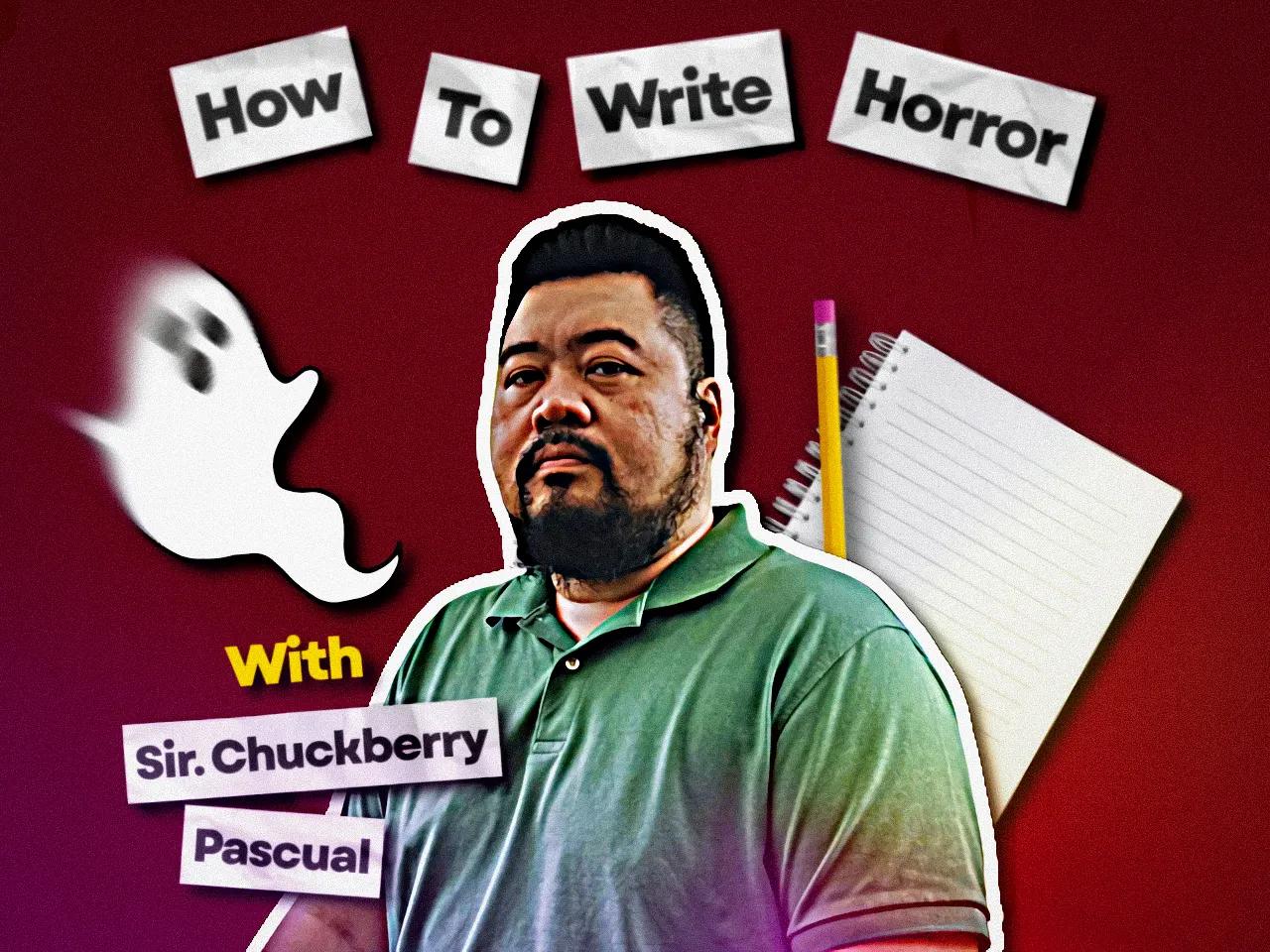
As October comes to a close, the season leaves readers with horror stories to keep or pass on. However, for Professor Chuckberry Pascual, these tales transcend mere fright, for what we fear reveals truths about us and our society.
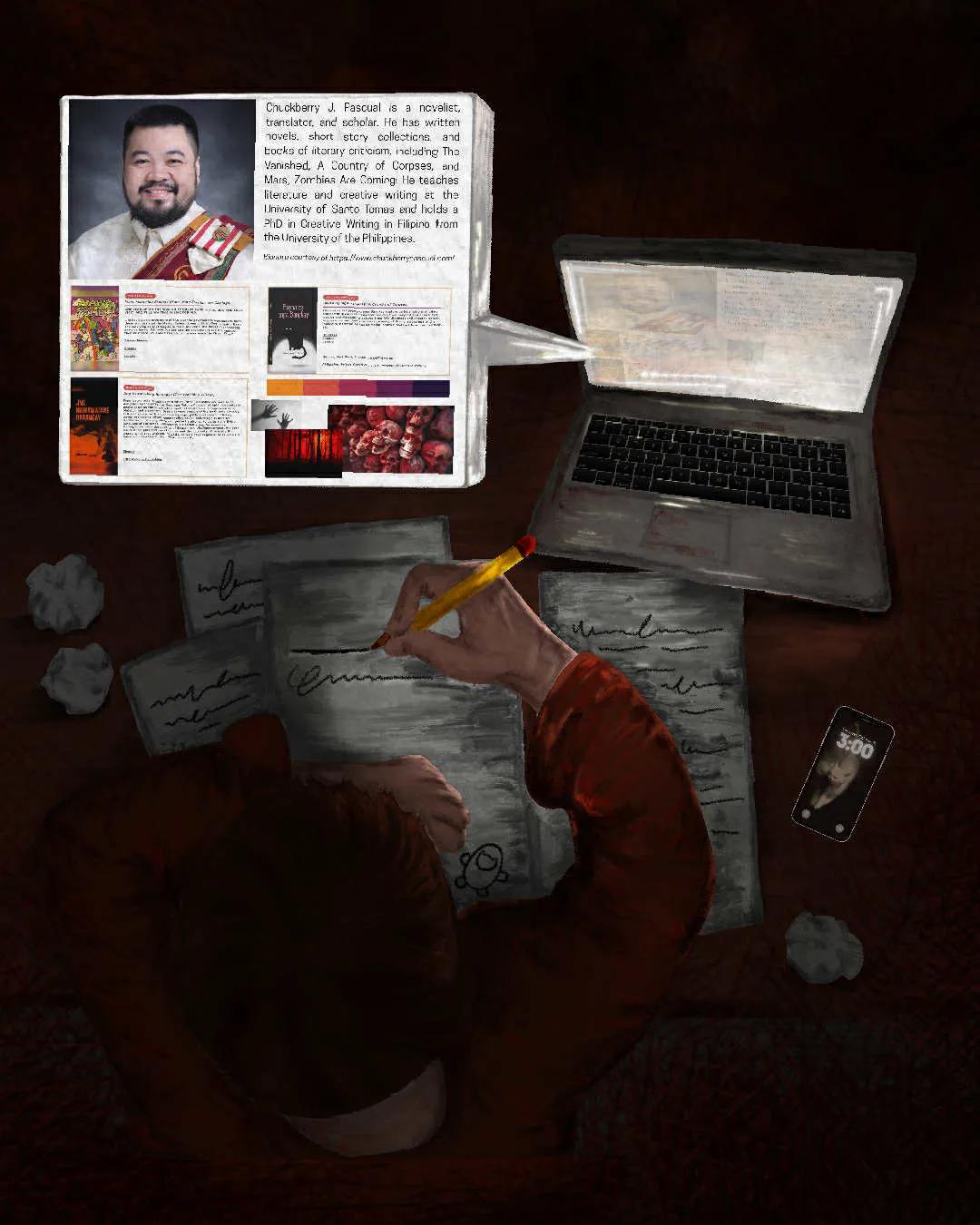
Pascual, a creative writing professor from the Faculty of Arts and Letters, has written a collection of horror and crime stories titled ‘Bayan ng mga Bangkay,’ and a duology of novels, “Mars May Zombie!” and “Mars, Maraming Zombie!”
His keenness for the genre began during his childhood.
“I read a lot of komiks and tabloids when I was young. Those are full of scary stories, real and fictional,” Pascual told TomasinoWeb via email.
When writing horror, Pascual believes there are no rules except the writer’s personal approach.
For him, fear may be deeply personal, so the first step is always to confront it. And so his process begins by asking himself three questions.
“I can’t prescribe a set way to write a horror story—there are as many ways of writing as there are writers—so I will just speak from my experience,” Pascual wrote. “‘What scares me?’, ‘How will I instill fear in the reader—through disgust, gore, or existentialist dread?’, [and] if featuring a monster or being, ‘what does it stand for?’” he added.
A step to scare
(Artwork by Chelo Bascal/TomasinoWeb)
While it is important for Pascual to explore one’s fear—it isn’t enough. For him, another key element to consider is the setting.
Regardless of genre, setting is vital. But in horror, it can either be a constraint or an opportunity to develop both plot and character.
“If I choose to set a story about an aswang in the city, I will have to consider the living conditions in an urban area, which are very different from those in a rural area,” he said.
Once the environment is established, the next challenge lies in how tension unfolds.
In horror stories, authors begin by escalating the suspense or unfolding the plot. Pascual notes that starting with a hook or intrigue—one that withholds information—can make the reveal more impactful.
This gradual buildup also extends to how the antagonist is presented. Pascual said that kontrabidas must be introduced seamlessly, not abruptly.
“Regardless of the genre—I’m not even sure if all stories have a proper 'antagonist'—the introduction of a character must be integral to the plot, i.e., natural and necessary,” Pascual wrote.
By letting the reader sense the presence of the antagonist rather than showing it outright, the story sustains its mystery and dread.
While other stories are either bound to end happily or tragically, horror allows for more ambiguity.
The antagonist may be revealed or kept hidden, depending on what the writer wants to achieve. Such decisions, Pascual explained, determine whether the story leaves a lingering and unsettling sense of dread.
“Usually, a closed ending gives the impression that the crime [or] transgression has been resolved, evil has been defeated,” he stated. “An open ending suggests that the conflict is not fully resolved, that evil continues to lurk,” the professor added.
Digging deeper into fright
Although he does not claim to be an expert, Pascual noted his observations on common mistakes made by horror writers.
“I do not consider myself an arbiter of good horror writing,” Pascual said. “So I offer this with tentativeness: it can be a missed opportunity if the 'scare' is just for the sake of being scary,” he added.
Pascual advised that writers aiming to frighten readers should tap into deeper, personal and even social anxieties.
This perspective is evident in his own works. In 2018, Pascual won Best Book of Short Fiction in Filipino at the National Book Awards and the San Alberto Magno Best Book at the Dangal ng UST Awards 2019 for his book “The Vanished” (Ang Nawawala).
The award-winning book is a comic, queer, Filipino detective novella set in the village of Talong Punay, where the protagonist searches for small, vanished objects and individuals, showing deeper issues and crimes within the town.
For the professor, executing a horror piece is not challenging. With a clear understanding of how to write it effectively, one can create a compelling and substantial story.
“Focus on the description—not just visual, try to engage the other senses—in building an atmosphere,” the professor noted.
His works often demonstrate this multidimensional approach to fear. Pascual wrote horror stories like “Sigbin,” “Kapre,” and “Kyawtibel” (2017). Two of these feature local mythology creatures, while Kyawtibel is an entirely invented mythological being.
He also wrote an adaptation of a story titled “Pusong’’ of the Juan Pusong Tales, reframing it as a story on violent activities. All of these are included in his latest book, “Mga Bubuyog na Nagkukumpulan,” a revised edition of his work “Kumpisal.”
To write horror is to write beyond the scare and enrich the plot's atmosphere; for Pascual, there is no strict formula in writing one.
The choice of ending, whether evil prevails or stops, entirely depends on what effect the writer wants to leave with readers: harmony after chaos or perturbing dread.
He emphasized that reflection lies at the core of his process, urging writers to probe deeper into the genre that could unfold and reflect the fears rooted in everyday life and society.
“If one knows how to write stories effectively—creating characters that are human, i.e., flawed and complex, crafting a balance between plot and character development—one will be able to create an effective horror story.”









Comments
Loading comments...
Leave a Comment